This week we move into the Design-Evaluation phase of the ADDIE model and discuss the 3 different domains of learning - Cognitive, Affective and Psycho motor.
Cognitive Learning has something to do with your thinking and knowledge. it enhances learner's knowledge.
There are 6 Outcomes in the Cognitive Learning as follows:
1. Knowledge - storing information and fact
2. Comprehension - understanding
3. Application - using what has been learnt previously
4. Analysis - recap
5. Synthesis - gathering all your knowledge
6. Evaluation - assessing what you have learnt and done so far.
Affective Learning is linked with feeling and attitudes, and it changes learner's attitudes.
There are 5 outcomes to Affective Learning.
1. Receiving - paying attention
2. Responding - participating
3. Valuing - accepting values/beliefs
4. Organization - categorize and internalize the values/beliefs
5. Characterization - adoption of values/beliefs
* the first 3 are the most practical to deal with instructions. It deals with the level of willingness of learners to accept what has been taught.
Psychomotor Learning involves doing, thereby, building learner's physical skills.
5 Outcomes to Psychomotor Learning
1. Perception - observations of behavior
2. Set - preparation for action
3. Guided Response - acting on assistance
4. Mechanism - acting without assistance
5. Complex Overt Response - auto pilot with facilitation
The next part about writing objectives involved 4 aspects - Audience, Behaviour, Condition and Degree.
Give an example:
Given the current economic situation (condition), Samsung (audience) is likely to cut down on manpower (behaviour) by up to 30% (degree) to maintain a low cost operation.
Tuesday, February 17, 2009

Wednesday, February 11, 2009
Week 5 - Needs Assessment
Today we are going through the lecture focusing on the Analysis-Evaluation aspect of the "ADDIE" model.
First of all, we need to understand the conditions under which "Need Assessment" is required.
A: There is a problem with the education system and thus, we need to find a solution
B: There may be a new technique/methodology/knowledge to pass on to the learners.
C: A re-assessment of whether the proposed goals from the learning programs are acheived.
So how do we go about carrying out "Need Assessment"?
Step 1: The 3-Face Model (Problem, Discrepency and Innovation model)
Step 2: Analyze the Goals
Step 3: Otuput of Analysis or Evaluate Step 1 & 2.
The Problem model focus on the problem itself. Whether it is due to learner's disability to learn or is it because of the environment/program he is subjected to. Determine whether solution to the problem can be applied through learning. If instruction that leads to desired outcome is given, go to Discrepancy model. Else, proceed to Innovation model.
The Discrepancy model focus on the goals to be achieved in the instructional system and whether they have been realized or not.
The Innovation model is to create new goals based on the changes to the learning system and afterward, check if the goals are appropriate in the system.
First of all, we need to understand the conditions under which "Need Assessment" is required.
A: There is a problem with the education system and thus, we need to find a solution
B: There may be a new technique/methodology/knowledge to pass on to the learners.
C: A re-assessment of whether the proposed goals from the learning programs are acheived.
So how do we go about carrying out "Need Assessment"?
Step 1: The 3-Face Model (Problem, Discrepency and Innovation model)
Step 2: Analyze the Goals
Step 3: Otuput of Analysis or Evaluate Step 1 & 2.
The Problem model focus on the problem itself. Whether it is due to learner's disability to learn or is it because of the environment/program he is subjected to. Determine whether solution to the problem can be applied through learning. If instruction that leads to desired outcome is given, go to Discrepancy model. Else, proceed to Innovation model.
The Discrepancy model focus on the goals to be achieved in the instructional system and whether they have been realized or not.
The Innovation model is to create new goals based on the changes to the learning system and afterward, check if the goals are appropriate in the system.
Wednesday, February 4, 2009
Week 4 - Learning Design Authoring and Technology Integration
Today I learnt about how to design learning for users based on the key elements of Task (square), Resources (triangle) and Support (circle).
"Task" is the work assigned to the learners. There are different types of Task:
1. Assimilative
2. Information Handling
3. Adaptive
4. Communicative
5. Productive
6. Experential
"Resources" refers to the source of supply of aids or support that can be used to help the learners understand better or it can enhance the teaching of the tutor.
"Support" can come in the form of human or computer feedback to help the learners evaluate what they have absorbed.
Also we discussed on the topic of Affordance. Here are the 3 attributes:
1. Actionable properties
2. Perceived actionable properties
3. Perceived actionable properties and the degree of perceptible information
Why do people designing learning?
- to transfer the burden of learning onto the learners themselves i.e. they learn by themselves through facilitation instead of a tradtional teacher-to-student method.
- improvement on Instructional Design (the ADDIE model)
There are 2 contrasting views on curriculum:
1. Ptolemaic - the ideas revolve around the task and activities
2. Copernican - the task and activities revolves around the idea.
Also, on the topic of Instructional Design, we have 5 stages - Analysis, Design, Development, Implementation and Evaluation.
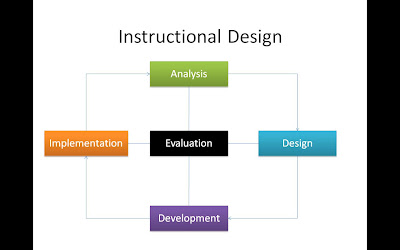 Analysis - analyze needs, targets etc.
Design - design macro and micro strategies etc.
Development - develop graphics, animations, video, audio etc.
Implementation - prepare platform, trainers and learners etc.
Evaluation - evaluating the course and report.
Although Instructional Design (ID) is effective in also has its fair shortcomings, including rigidity of the structure and the length of time it takes to implement, expensive and inflexible and the integrity of the analysis hangs on the appropriateness of the methods used and their applications.
"Task" is the work assigned to the learners. There are different types of Task:
1. Assimilative
2. Information Handling
3. Adaptive
4. Communicative
5. Productive
6. Experential
"Resources" refers to the source of supply of aids or support that can be used to help the learners understand better or it can enhance the teaching of the tutor.
"Support" can come in the form of human or computer feedback to help the learners evaluate what they have absorbed.
Also we discussed on the topic of Affordance. Here are the 3 attributes:
1. Actionable properties
2. Perceived actionable properties
3. Perceived actionable properties and the degree of perceptible information
Why do people designing learning?
- to transfer the burden of learning onto the learners themselves i.e. they learn by themselves through facilitation instead of a tradtional teacher-to-student method.
- improvement on Instructional Design (the ADDIE model)
There are 2 contrasting views on curriculum:
1. Ptolemaic - the ideas revolve around the task and activities
2. Copernican - the task and activities revolves around the idea.
Also, on the topic of Instructional Design, we have 5 stages - Analysis, Design, Development, Implementation and Evaluation.
 Analysis - analyze needs, targets etc.
Design - design macro and micro strategies etc.
Development - develop graphics, animations, video, audio etc.
Implementation - prepare platform, trainers and learners etc.
Evaluation - evaluating the course and report.
Although Instructional Design (ID) is effective in also has its fair shortcomings, including rigidity of the structure and the length of time it takes to implement, expensive and inflexible and the integrity of the analysis hangs on the appropriateness of the methods used and their applications.
Tuesday, January 20, 2009
Week 2
Today we were introduced to various methods of E-Learning via websites and videos, as well as images. We were shown some videos on the concepts of Behaviourism, Cognitivism and Sociocultural.
Behaviourism
Humans are either deterred (compelled) to carry out a certain action by the use of punishment (reards). Behaviourism kicks in when the treatment we received, as a result of executing the action, affects us in a positive or negative ways. It falls on the basis of selfish human nature to attain personal goals or satisfaction.
Cognitivism
Humans are constantly trying to make sense of the world they are living in; trying to rationalize their every actions and finding a purpose for each of them. It falls on the basis that humans are by nature, curious people and always seeking to discover new things. They have an intrinsic motivation to learn/know.
Sociocultural
This concept focuses on the person as being part of a collective system, rather than being individualist. Learning takes place when people interact with one another or with the system with which they are connected to/with. The cohesiveness of the system depends on the individuals themselves. Humans are placed within a certain system and function to the best of their personal skill or knowledge set, thus, developing their personal set of view points/opinions.
Assignment
I have read Mathilda, Jacintha Sim and Sim Zhi An's blog for the second week.
I commented on Mathilda's blog.
Behaviourism
Humans are either deterred (compelled) to carry out a certain action by the use of punishment (reards). Behaviourism kicks in when the treatment we received, as a result of executing the action, affects us in a positive or negative ways. It falls on the basis of selfish human nature to attain personal goals or satisfaction.
Cognitivism
Humans are constantly trying to make sense of the world they are living in; trying to rationalize their every actions and finding a purpose for each of them. It falls on the basis that humans are by nature, curious people and always seeking to discover new things. They have an intrinsic motivation to learn/know.
Sociocultural
This concept focuses on the person as being part of a collective system, rather than being individualist. Learning takes place when people interact with one another or with the system with which they are connected to/with. The cohesiveness of the system depends on the individuals themselves. Humans are placed within a certain system and function to the best of their personal skill or knowledge set, thus, developing their personal set of view points/opinions.
Assignment
I have read Mathilda, Jacintha Sim and Sim Zhi An's blog for the second week.
I commented on Mathilda's blog.
Wednesday, January 14, 2009
Week 1
I did not attend lecture for this week due to a bad headache the day before. However, I did some read up on the lecture reading and the notes.
The lecture slides provided some insights on the discussion and definition of what e-Learning is all about. It takes on the fundamental form of learning through the usage of, but not only limited to electronic technology. E-learning can be represented in various forms, through different mediums, with examples like E-books, digital video, virtual learning, games and html etc.
According to the reading of Rosenberg, The e-Learning Revolution, the traditional classsroom-style, teacher-to-students teaching method is swiftly being replaced by e-learning as science and technology advances throughout the decades. It brings us back on a history journey to discover how learning/teaching methods have evolved over the years and flashes images of what used to be defined as conventional; now has been superseded by the technology that we have become so enslaved to.
As for the other 2 readings, I have yet to finish them.
The lecture slides provided some insights on the discussion and definition of what e-Learning is all about. It takes on the fundamental form of learning through the usage of, but not only limited to electronic technology. E-learning can be represented in various forms, through different mediums, with examples like E-books, digital video, virtual learning, games and html etc.
According to the reading of Rosenberg, The e-Learning Revolution, the traditional classsroom-style, teacher-to-students teaching method is swiftly being replaced by e-learning as science and technology advances throughout the decades. It brings us back on a history journey to discover how learning/teaching methods have evolved over the years and flashes images of what used to be defined as conventional; now has been superseded by the technology that we have become so enslaved to.
As for the other 2 readings, I have yet to finish them.
Subscribe to:
Posts (Atom)